
What is Psoriatic Arthritis?
Psoriatic Arthritis (PsA) is a chronic inflammatory arthritis that develops in association with psoriasis — a skin condition characterised by scaly, red, and itchy patches. Approximately 30% of people with psoriasis will develop PsA, which causes joint inflammation, pain, and stiffness. PsA belongs to the spondyloarthropathy family and can affect joints, tendons, ligaments, the spine, and the eyes.
PsA is a heterogeneous disease with 5 distinct clinical subtypes: oligoarticular (few joints), polyarticular (resembling RA), axial (spine involvement), distal interphalangeal (DIP joint predominant), and arthritis mutilans (the most destructive, rare form). This clinical diversity means that two PsA patients can look completely different — one may have only psoriatic nail disease and a swollen knee, while another has severe spinal disease and 15 swollen joints.

Dactylitis ("sausage digit") and nail pitting — two hallmark features of Psoriatic Arthritis.
Hallmark Features
Several clinical features are highly characteristic of PsA and help distinguish it from other forms of inflammatory arthritis:
- Psoriasis: Skin or nail psoriasis, which may precede arthritis by years. Nail changes (pitting, onycholysis, subungual hyperkeratosis) are particularly strongly associated with joint involvement.
- Dactylitis ("Sausage Digit"): Uniform swelling of an entire finger or toe due to simultaneous inflammation of the joint and the tendon sheath. This is highly specific to PsA and reactive arthritis.
- Enthesitis: Inflammation at the insertion of tendons and ligaments into bone. The most common sites are the Achilles tendon and the plantar fascia at the heel, causing severe heel pain.
- Asymmetric Arthritis: Unlike RA (which is symmetrical), PsA often affects joints asymmetrically.
- DIP Joint Involvement: Inflammation of the distal interphalangeal joints (the last knuckle of the finger) — a feature very unusual in RA but common in PsA.
- Negative Rheumatoid Factor: PsA is a "seronegative" arthritis — Rheumatoid Factor and anti-CCP antibodies are typically absent, helping to distinguish it from RA.
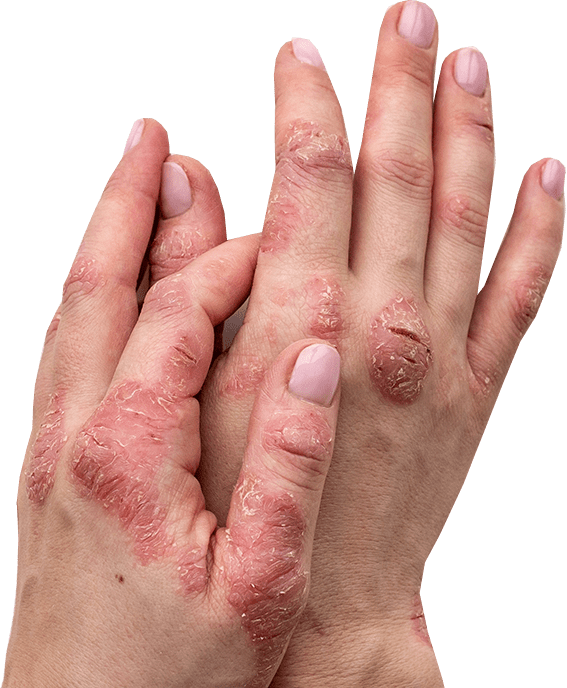
Scaly psoriatic skin plaques — the cutaneous manifestation that frequently precedes or accompanies joint disease.
🔬 CASPAR Criteria
PsA is diagnosed using the validated CASPAR (Classification criteria for Psoriatic ARthritis) criteria, which assign scores to psoriatic skin/nail disease, a negative Rheumatoid Factor, dactylitis, radiographic changes, and new bone formation. No specific blood test confirms PsA — diagnosis is clinical.
Comprehensive Treatment Strategy
PsA management aims to control both the skin and joint disease simultaneously — ideally with a single agent. Treatment is selected based on the dominant manifestation (skin vs. joints vs. spine):
Conventional Therapy
Methotrexate is the most commonly used conventional DMARD for PsA. It effectively controls peripheral joint disease and skin psoriasis. Other options include Leflunomide and Sulfasalazine (particularly for enthesitis).
Biologic Therapies — A Skin and Joint Dual Benefit
- TNF Inhibitors (Adalimumab, Etanercept, Infliximab) — effective for both joints and skin.
- IL-17 Inhibitors (Secukinumab, Ixekizumab) — particularly powerful for skin clearance, enthesitis, and axial disease.
- IL-12/23 Inhibitor (Ustekinumab) — a convenient every-12-week injection with excellent skin and joint efficacy.
- IL-23 Inhibitors (Guselkumab, Risankizumab) — the newest biologics with outstanding skin clearance data and emerging joint efficacy evidence.
- PDE4 Inhibitor (Apremilast) — an oral tablet effective for mild-moderate joint and skin disease.
- JAK Inhibitors (Tofacitinib, Upadacitinib) — oral medications with biologic-level efficacy for both skin and joints.
Dr. Prateek's Approach to Psoriatic Arthritis
PsA sits at the intersection of Rheumatology and Dermatology, requiring a physician who understands both the joint and skin manifestations deeply. Dr. Prateek Deo is skilled in managing the full spectrum of PsA, from mild peripheral joint disease to severe axial, multi-domain disease with skin, nail, and enthesitis involvement.
Skin + Joint Care
We choose therapies that simultaneously treat psoriatic skin plaques AND joint inflammation, giving you comprehensive relief with a single agent where possible.
Precision Classification
We carefully identify your PsA subtype (axial, oligoarticular, polyarticular) to ensure the right treatment is selected from the start.
CASPAR Assessment
We use internationally validated CASPAR criteria and composite disease activity scores to guide and adjust treatment systematically.
Cardiometabolic Vigilance
PsA is associated with higher cardiovascular risk. We proactively screen and manage metabolic syndrome, hypertension, and diabetes alongside arthritis treatment.